THE FUTURE OF ECOMMERCE: EMERGING TRENDS AND TECHNOLOGIES SHAPING THE INDUSTRY
The buying and selling of goods or transfer of funds over the internet is called eCommerce. Adoption of ecommerce is swiftly growing across the world. The UK market has contributed to a worldwide growth rate of 8.7% in 2023. It is a business that requires minimal investment and gives good returns.
But is the future of eCommerce also as bright as its present? Growing adoption and increasing number of online buyers suggest that the answer is Yes. As of 2023, there are 2.64 billion digital buyers in the world. It means if you start ecommerce business, almost 33% of the world could be your potential buyers.
However, you must know the industry landscape, and understand its trends to make the most of this opportunity. This article is a brief overview of the trends and technologies that would shape the future of e-commerce.
The Current state of ecommerce
Ecommerce is a rapidly evolving industry. Users loved it from the beginning for two major reasons. First, they could purchase any time from their beds. Second great thing was the delivery to the doorstep. But there were also limitations like no option to try before you buy. Also, there were risks of fraud and scam.
But with the progress of technology, e Commerce also continued to improve. Then in 2020 global pandemic also pushed the consumers to buy online. On the other hand, it also created the need to make digital shopping better and fill the loopholes.
Today, ecommerce is a flourishing industry. The United Kingdom market size is expected to jump from USD 230.41 billion in 2023 to USD 616.62 billion by 2028 , at a CAGR of 21.76% during the forecast period (2023-2028).
E-commerce deals with sale of purchase of both services and products. You can sell jewellery, clothes, books, medicines, gadgets, furniture, vehicles, culinary items, and anything under the sun. Multiple business models are practised in the industry.
The competition is increasing as more and more people launch their ecommerce stores. By 2027, at least 25% of retail sales will be online. You could miss out on a lot of opportunities if you do not jump in today.
As a consumer you can enter any day. But as a businessman, you must enter as soon as possible.
Business analysts use many performance indicators to analyse the performance of an ecommerce business. There are three types of key performance indicators. First type of metrics highlights product or service discovery. Second type deals with consideration. And the third type discusses conversion. It is best to track these metrics on a weekly or at least bi-monthly basis.
The following graph by Tribune shows the progress of the e-commerce industry in the last four years. No doubt, the future of e-commerce looks promising.

Emerging trends in ecommerce
Metrics tell you almost everything about the performance of your ecommerce store. However, to get good metrics you need good strategies. And to devise good strategies, the knowledge of trends and technologies is critical. Here are some trends that are driving the present and shaping the future of ecommerce. Keeping them in mind would help you make better ecommerce business plans .
Multi-channel sales is new norm
Single channel is not enough in modern times. Rather brands that utilise as many channels as possible to gain maximum customers. Businesses use Facebook marketplace, google marketplace as well as eBay. They also use platforms like Twitter, Tiktok, LinkedIn, and YouTube.
Omnichannel marketing would be critical to success
The approach of omnichannel marketing is also on rise. It's critical to understand the difference between omnichannel marketing and multi-channel marketing.
Omnichannel marketing focuses on building an organised and better customer experience. It makes sure that the customers get the same message across all channels. It synchronises all digital channels with each other and with brick-and-mortar stores.
No matter whether the customers are physically present in the brick-and-mortar store or checking the products on social media pages or the official website, they have the same seamless experience. For example, some businesses even display the online reviews of the product in the gallery of the brick-and-mortar store.
Rise of mobile commerce
Smartphones are an integral part of our lives today. As of statistics, 55% of internet traffic comes from mobile devices . So, the trend of using mobile devices to shop has also seen a massive surge in recent years. In the year 2021, mobile e-commerce sales accounted for 72.9% of total e-commerce sales .
So, businesses must ensure optimising their website for mobile viewing. Design should be mobile-friendly, and load-time should be fast enough for mobile viewers. The check-out process should be effortless.
Not only should it be mobile-friendly, but there must be a mobile app for your ecommerce business. So, users can easily buy your products.
Personalised shopping experience for every consumer
Today’s consumers, whether B2B or B2C, look for personalised and customised shopping experience. They are more likely to convert if they feel like the brand directly communicates with them. Wondering how a single brand can personally interact with millions of people? Artificial Intelligence has changed this impossible into possible.
Ecommerce businesses now offer personalised product recommendations to engage their customers. They offer specific content that interests customers. This specific content is made with the help of past customer behaviour, demographics, and location. It is a proven method to bring sales. One study finds that personalisation brings at least 25% more profit.
Use of data & analytics to drive business decisions
92.1% savvy organisations increased their revenue through data analytics. Data analytics helps understand consumer behaviours. You get to understand the factors that influence the buying decisions. The goal of data analytics in ecommerce is to improve the online shopping experience and increase sales.
Voice commerce is the future
Voice commerce is getting popular day by day. Assistants like Siri & Alexa give the human touch, and fill the gap of e-commerce stores, and customers love that. A recent study finds that 58% of customers have used voice search in the past year. It uses technologies like Natural Language Processing & Machine learning to respond to customer queries.
Customers can give voice commands to find the desired product or complete the purchase. They offer promotions and help personalise the shopping experience. That naturally leads to increased sales and conversions, which is all what business owners want.
So, we can expect further rise in the trend in future, as the technology of voice recognition improves. Future buyers won’t be needing a mouse to scroll over the website. A simple voice command would be doing a range of tasks from product recommendation to order tracking & quick add to cart. Voice commerce would definitely be a game changer and the future of ecommerce.
Emerging technologies in ecommerce
With the advance technologies, ecommerce continues to revolutionise the way humans buy and sell products and services. Let's explore some technologies that would be shaping the landscape of the future ecommerce industry. These three changes would make the shopping experience strikingly different.
Internet of things (IoT) will innovate ecommerce solutions
IoT allows physical objects to connect with each other and exchange data. The technology has a lot to offer to make ecommerce solutions smart. However, their most uses exist in real-time and not in virtual stores.
First, IoT sensors can use data collection, track consumer behaviour, and offer personalised experience. Secondly, in brick-and-mortar stores, they let customers make transactions without using their wallets. A sensor detects what product a customer picks up and charges them automatically when they leave.
IoT helps with inventory management and lets retailers know which product is out of stock. They also help with packaging and supply chain management.
Chatbots & virtual assistants will augment the efforts of customer support
You cannot be available for your customers 24/7 but chatbot can be.
E-commerce requires zero initial cost. But what about the cost of customer support? Well, chatbots eliminate that cost too. You do not need a big customer support team. You will only need a good chatbot and some virtual assistants to offer your customer instant support.
And chatbots also fulfil the personalisation needs in the best way possible. A customer support staff talking to you politely and asking how they may help is a great feeling that ecommerce did not offer in the past. In the near future, this gap would also cease to exist. That is why chatbots and virtual assistants are the future of ecommerce, since they fulfil basic conversational needs of humans.

A well-integrated chatbot shares the burden of human customer support staff. On the other hand, they provide instant assistance to customers. Hence, their popularity in e-commerce is increasing day by day. Businesses use them to offer seamless personalised experiences to their customers.
Chatbot can handle routine queries, while a virtual assistant assists in complex tasks. Integration of chatbots and e-commerce will be the norm in the coming times.
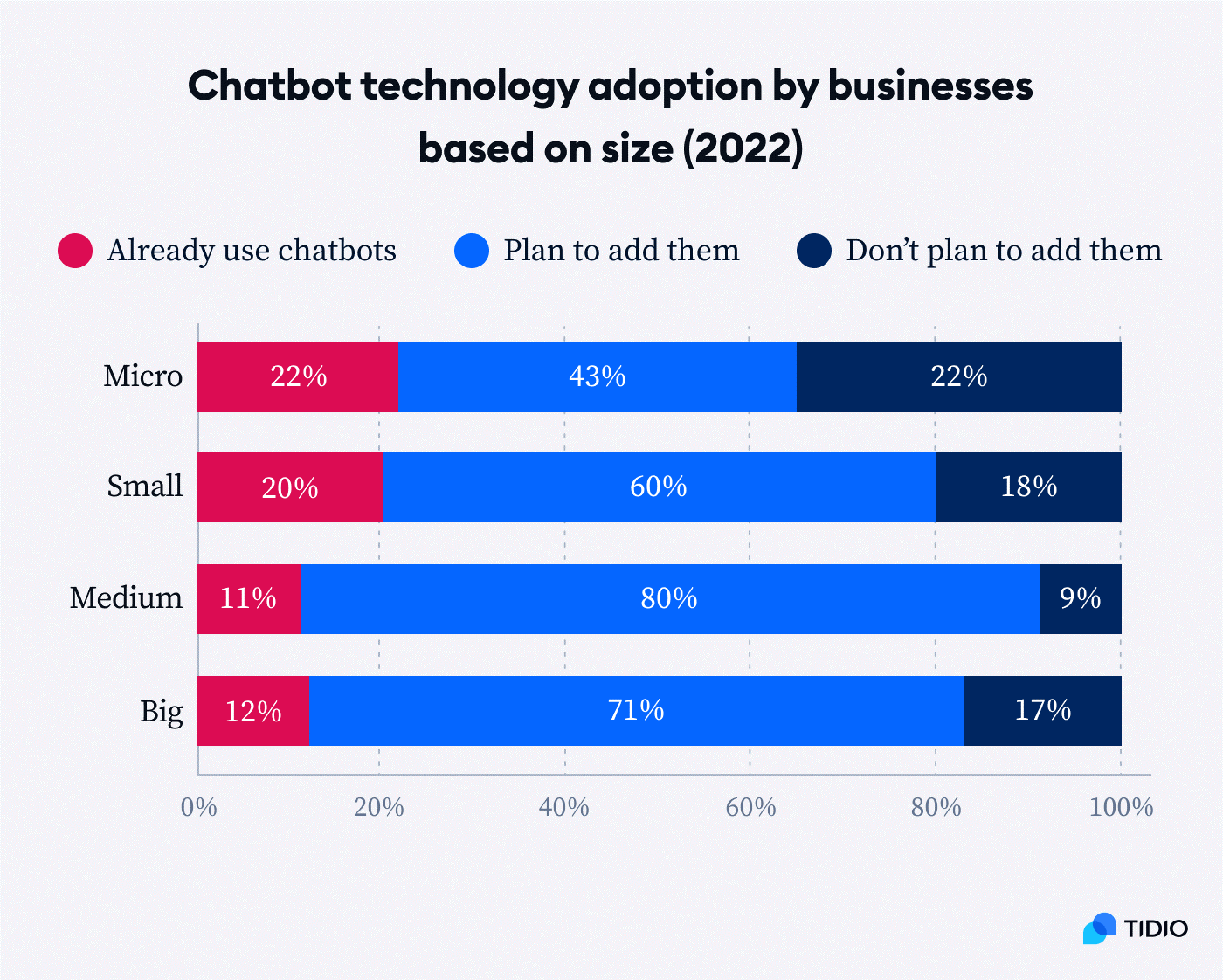
Customer loyalty is a need of every ecommerce business. These technologies improve customer engagement and reduce response times. That leads to higher customer satisfaction and loyalty. Following graph shows quick adoption of chatbot technology by business. The trend is here to stay.
Augmented reality (AR) & virtual reality (VR) will transform the shopping experience
While chatbots overcome the limitation of no human conversation, AR and VR removed another. Another loophole of buying online has been being unable to try products in real time before buying.
The technologies of VR and AR have almost filled this gap. Together, they offer a virtual try-on experience, which, for example, lets you see how you would look in a dress you are considering. Virtual try-on and fitting rooms of AR bring in-store experience to customers’ screens. Customers can easily visualise how a product looks in real-time in a fun way.

It is a real game-changer technology in e-commerce, especially for the fashion and home decor industries. It lets you see how furniture would look in your room. Hence, they increase customer trust and decrease the number of returns. In a survey by NielsenIQ, 61% of shoppers said they prefer to buy with a store that offers AR features .
The brand Warby Parker offers virtual try-ons for different glasses to help you find the perfect fit.

What would the new world look like?
The E-Commerce industry has changed a lot since its inception. Changing buying behaviours and trends show it will continue to evolve in the future. As technology advances, more and more people will start using it to buy and sell. Experts predict many major changes, and here are the most notable ones.
1. The job market would surely change. New job roles would emerge. E-commerce has even introduced new jobs in customer service and logistics.
2. Traditional retail job roles will decline.
3. The rise of the gig economy is also expected.
4. The use of technologies like Artificial Intelligence, Machine Learning, Internet of Things, and AR will also rise.
5. Supply chain and logistics will also observe some changes. Some are same-day and next-day delivery. With the rise of e-commerce giants, customers will expect faster deliveries.
6. Another impact on supply chain and logistics is automation. Businesses will also use robots for order picking, packing, and shipping.
7. E-commerce would have a dual impact on the environment. On the one hand, it is good since fewer people will travel to shops and fewer vehicles will work. On the other hand, it will make more data centres operate.
8. Requirements of business will also change. As businesses use e-commerce to reach out to other companies, the need for great B2B commerce solutions will also increase. Future businesses will need a platform with well-managed inventory, easy order tracking, and multiple payment options.
Conclusion
The future of e-commerce is bright as an industry. As a business owner, the future would be bright if you jumped in at the right time. Undoubtedly, it has opened a world of opportunities for small businesses and entrepreneurs.
Small and new businesses can also reach the global market and compete with big companies. However, big companies have already built a reputation, while new businesses struggle to develop it. They must be double cautious about providing a great shopping experience to their customers.
WowCommerce is an innovative e-commerce solution that helps you manage your store, represent your business niche beautifully, and let your customers enjoy a great user experience. Reach out at info@wowcommerce.co.uk or 0115 786 0268 friendly team of experts would help you at this email or number.
Success needs the right solution and the proper knowledge. The same is true in the e-commerce industry. Use the right tool and get the appropriate knowledge of trends & technologies. You should know the importance of personalisation, data analytics, voice commerce, Omni, and multi-channel marketing.